Professional tree surgery covers a wide range of services designed to manage trees, hedges and unwanted stumps. The work may involve improving a tree’s structure, creating clearance around a property, removing damaged branches or carefully dismantling a tree that can no longer remain in its position.
The correct service depends on the tree’s species, age, condition and surroundings. For property owners in Ware, Hertfordshire, a professional assessment can identify what work is genuinely required and prevent unnecessary cutting.
Tree Surgery Services for Managing Trees and Outdoor Spaces
Tree surgeons use specialist knowledge, equipment and working methods to care for trees safely and appropriately. Understanding the main services available can help property owners make an informed decision when a tree becomes overgrown, damaged or unsuitable for its location.
Tree Inspections and Assessments
A professional assessment is often the first stage of tree surgery. The tree surgeon examines the trunk, main branches, canopy and visible root area while considering the tree’s relationship with nearby buildings and garden features.
This process can identify deadwood, cracks, cavities, weak branch unions, excessive growth and signs of decline. The findings help determine whether pruning, crown management, felling or simple monitoring is appropriate.
Tree Pruning and Trimming
Pruning removes selected branches to improve clearance, manage growth or address damaged and poorly positioned limbs. The cuts should be chosen according to the tree’s structure and natural growth pattern.
Professional pruning avoids removing more material than necessary. It can help prevent branches from obstructing paths, touching buildings or interfering with other parts of the garden while retaining a balanced canopy.
Crown Reduction
Crown reduction decreases the overall height, spread or both by shortening selected branches throughout the canopy. It may be suitable when a tree has become too large for its surroundings or has developed long, overextended limbs.
The aim is to retain a natural outline rather than leaving a heavily cut or unbalanced appearance. The amount of reduction must reflect the species, condition and maturity of the tree.
Crown Lifting
Crown lifting removes or shortens lower branches to increase the clearance beneath the canopy. This can improve access over paths, driveways, lawns and seating areas.
The work must be carefully planned because removing too many lower branches can affect the tree’s balance and create large wounds around the main stem. Selective lifting usually provides the required clearance while retaining a proportionate crown.
Crown Thinning
Crown thinning involves removing selected smaller branches from throughout the canopy. It can reduce density and allow more light and air to pass through without substantially changing the tree’s overall dimensions.
This service is not appropriate for every tree or every concern. A tree surgeon should first determine whether thinning will provide a genuine benefit or whether another type of pruning would be more effective.
Deadwood Removal
Dead branches can develop because of age, shading, weather damage, disease or natural growth processes. Removing significant deadwood may reduce the likelihood of branches falling into frequently used areas.
A professional tree surgeon can distinguish dead branches from healthy growth and identify suitable access and removal methods. Smaller dead twigs in less-used areas may not always require intervention, so the location and size of the material should be considered.
Removal of Damaged Branches
Cracked, split or partially detached branches can require prompt attention, particularly when positioned above buildings, paths or garden structures. Their movement may become less predictable during wind.
The branch may be removed completely or reduced to a suitable point, depending on the extent of the damage and its attachment to the tree. The remaining canopy should also be checked for related weaknesses.
Tree Felling
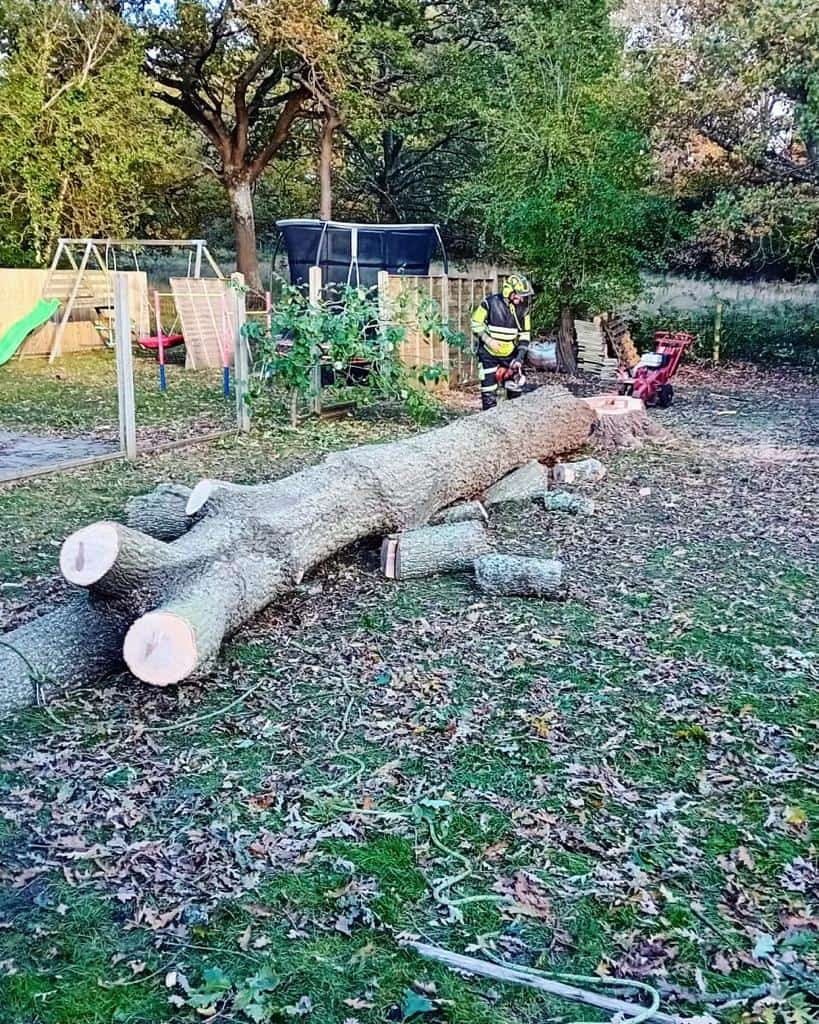
Tree felling may be recommended when a tree is severely damaged, declining, unsuitable for its location or cannot be managed effectively through pruning. Where sufficient space is available, the tree may be felled in a controlled direction.
Careful planning is essential. The tree’s lean, weight distribution, condition and surroundings all influence how the work should proceed.
Sectional Tree Dismantling
When there is not enough space to fell a tree in one piece, it can be dismantled gradually. Branches are removed in a planned sequence before the trunk is lowered in manageable sections.
Ropes and rigging equipment may be used to control material above roofs, fences, sheds or valuable planting. This method allows trees to be removed from confined spaces with greater control.
Stump Grinding
After a tree has been removed, the remaining stump may obstruct mowing, planting or future landscaping. Stump grinding uses specialist machinery to reduce it below the surrounding ground level.
The required depth depends on how the area will be used afterwards. Grinding removes the main obstruction, while the remaining underground roots are generally left to break down naturally over time.
Hedge Cutting and Reduction
Tree surgeons may also manage established hedges. Services can include routine trimming, height reduction, reshaping and the gradual restoration of overgrown growth.
Different hedge species respond differently to hard cutting. Identifying the plant and its condition helps determine how much material can be removed without leaving avoidable gaps or affecting healthy regrowth.
Storm-Damaged Tree Work
Strong winds can break branches, split unions or leave trees unstable. Storm-related work begins with an assessment of the damaged tree and the surrounding area.
Loose or suspended branches may need to be removed first, followed by work to rebalance the remaining canopy where appropriate. In some cases, severe damage may make complete removal the safest practical option.
Managing Trees Near Buildings
Trees growing close to homes, garages, walls and other structures often require precise management. Branches may need shortening to provide clearance, while overextended limbs may require selective reduction.
The objective should be to resolve the specific problem without automatically carrying out excessive pruning. The tree’s future growth and likely maintenance needs should form part of the recommendation.
Why the Correct Service Matters
Tree surgery techniques are not interchangeable. Crown reduction, thinning, lifting and general pruning each serve different purposes. Choosing the wrong approach can fail to solve the original problem and may place unnecessary stress on the tree.
A professional recommendation should explain:
- what condition or growth requires attention;
- which tree surgery method is appropriate;
- how much material should be removed;
- what the finished tree is expected to look like; and
- whether future maintenance is likely to be needed.
This gives property owners a clear understanding of the proposed work before it begins.
Conclusion
Tree surgeons provide services including inspections, pruning, crown reduction, crown lifting, deadwood removal, tree felling, sectional dismantling, stump grinding and hedge maintenance. The most suitable option depends on the tree’s condition, position and the result that needs to be achieved.
If you need professional tree surgery at your property in Ware, Hertfordshire, Ware Tree Surgeons can assess the tree and recommend an appropriate course of action. Contact us to arrange an inspection and receive practical guidance based on your outdoor space.
Call us on: 01992 932 299
Click here to find out more about Ware Tree Surgeons
Click here to complete our contact form and see how we can help with your tree care needs.